Language matters because the way we describe a field shapes how we think about it—and consequently how we fund it, programme it, research it and build infrastructure around it. Yet “art and technology” is frequently used interchangeably or as a catch-all term for media art, digital art, creative technology, immersive experiences, and many other practices across different art forms.
In this paper, I use “technology” in the practical rather than philosophical sense: digital, electronic, computational, biological and other technologies involving software, hardware, networks, sensors, screens, or kinetic and electromechanical systems.
Rather than attempting to define the field once and for all, I propose three frameworks for thinking about art and technology. Together, they ask three questions: what kinds of work exist within the field; why different actors invest in that work; and what functions an ecosystem needs in order to sustain it. These move from artistic practice to value creation to ecosystem development.
These frameworks are intended as thinking tools rather than metrics for what a “successful” ecosystem should look like. The Annexes contain illustrative examples of how they might be applied.
Note
These frameworks were formalised while working on an internal strategic review for Tusitala, and draw on my experience as an arts practitioner and arts manager in Singapore. They are also informed by conversations with artists and institutions across the region, observations during travel throughout East and Southeast Asia, and a review of existing ecosystem mapping reports.
These frameworks are intended primarily for people working around the field: arts managers, policymakers, funders, institutions, curators, producers, community organisers, and others involved in developing, supporting or explaining art and technology. They offer different ways of organising the field, and can be applied to different questions depending on the user and context.
Framework 1: Art and technology practice matrix
Before we can build better ecosystems, we first ask what types of work are part of “art and technology”. I first sketched this matrix on a whiteboard around 2023 in the Potato Productions office after repeatedly finding myself in conversations that treated art and technology as a single, coherent monolith, as though both “art” and “technology” did not already exist along spectrums of their own. Rather than debating definitions, I wanted a simple way of visualising diversity.
How it works
The matrix is intended for practices where technology is central to the artistic proposition. For example, a theatre production that uses projection mapping as scenography would not typically fall within its scope.
The matrix maps works and practices along two dimensions. The horizontal (“technology”) axis represents the maturity of the dominant technologies involved, ranging from established to emerging. The vertical (“art”) axis represents the dominant artistic orientation of the practice, ranging from work that is primarily immediate and experiential to work that is primarily conceptual and discursive. Neither axis is intended as a value judgement; they simply describe two dimensions along which practices vary.
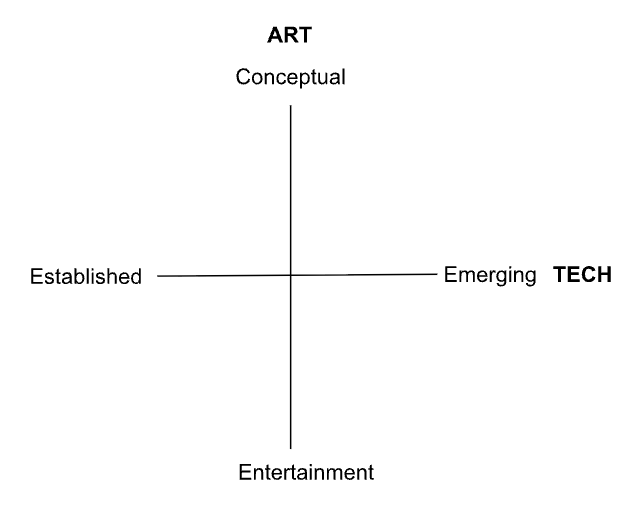
I chose these two dimensions for a simple reason: because the framework is called “art and technology,” one axis maps the art and the other maps the technology. Two useful questions asked about any work in this field: what technology does it use, and what is the artistic intention behind it? Together they reveal why two projects built with the same technology can nonetheless occupy very different positions.
Why scales rather than mediums
This is intended as a practical tool for making more precise distinctions between practices. It treats both dimensions as continuous scales, with works occupying different positions along each axis. For example, an AI video work that is highly conceptual is very different from an AI film intended for theatrical release, and hence might circulate among different audiences and receive different critical reception.
How it can be used
Beyond categorising individual works or practices, this framework can also be useful when programming, commissioning, or funding decisions require more precise distinctions. It can help organisations articulate their focus: an institution might identify that it works primarily with emerging technologies, or that it prioritises conceptual and discursive work over experiential formats, or conversely that accessibility and broad public engagement are central to its mission. Used this way, the matrix can help clarify one’s position within the field.
The framework does not account for artistic quality, ambition or intent, nor does it suggest that one quadrant is inherently more valuable than another. It is also temporal: an artist might sustain a highly conceptual practice while also producing commercial work; VR itself has moved from an emerging experimental medium to a relatively established one. Neither does it engage with deeper questions about the different types of complex relationships between art and technology (i.e., whether they are separate domains, overlapping practices, or some other model entirely, etc.).
Framework 2: Motivations and value
One of the many things that surprised me after moving into art and technology was the sheer diversity of people who were interested in it. I often found myself in sometimes odd conversations with an unexpectedly wide range of people outside the field, such as designers, futurists, researchers, scientists, technologists and even venture capitalists. Although they all expressed an interest in art and technology, it gradually became clear that they were often looking at it from different perspectives.
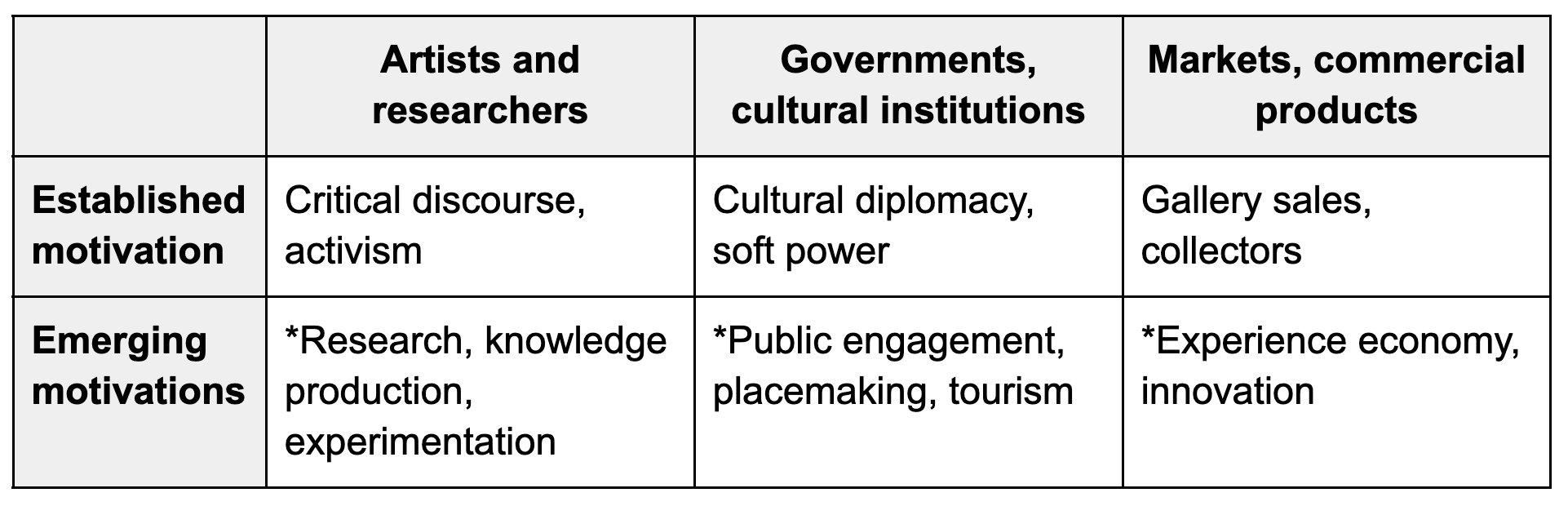
Rather than asking who participates in the ecosystem, this framework asks a different question: Why do they invest and what do they get out of it? It maps three broad investor groups and the distinct forms of value they seek.
Why motivations rather than actors
Making these motivations visible helps explain why art and technology attracts such a diverse range of actors, and why collaborations succeed or fail. Successful collaborations may depend less on shared motivations than on aligned expectations about the kinds of value a project can create.
This framework maps the motivations of those who fund, commission and present art and technology, rather than the intentions of the artists who make it. A work may be created for deeply personal, aesthetic or exploratory reasons while simultaneously generating cultural, commercial or research value. Recognising these instrumental outcomes does not diminish the intrinsic value of the work; it simply acknowledges that different participants may find different kinds of value in the same work.
The second row points to three areas where art and technology appear to have particular advantages. Because it naturally intersects with science and engineering, lends itself to immersive and participatory experiences, and sits close to innovation ecosystems, the field is especially well placed to contribute to research, large-scale public engagement, and commercial innovation.
How it can be used
This framework invites practitioners to look beyond familiar funding models by mapping what different actors actually value, and where those values might align. Art and technology often sits at the intersection of arts, research, technology and industry, creating possibilities for partnerships and investment that may not exist in the same way for more conventional arts practices. Understanding what different actors value can help practitioners look beyond familiar funding and institutional models, and think more ambitiously about the kinds of relationships they build. For arts managers, policymakers, funders and other cultural intermediaries, the framework can also be used to ask what value a particular project is expected to create, for whom, and whether those expectations are shared across the different parties involved.
The categories are not exhaustive, and a single project may span multiple motivations or move between them over time as technologies mature, institutions evolve and new forms of value emerge.
Framework 3: Functions within an ecosystem
Over the past few years, I had the privilege of visiting organisations, festivals and institutions across East and Southeast Asia. Every ecosystem seemed to have its own mix of policies, funding structures, organisations and programmes. At first, the sheer variety was bewildering. But the more I compared them, the more I realised that the ecosystems were also remarkably similar.
This prompted me to stop asking whether one country had an equivalent of a particular institution or programme, and instead ask what they actually did. What roles need to be performed, and by whom?
Why functions rather than organisations
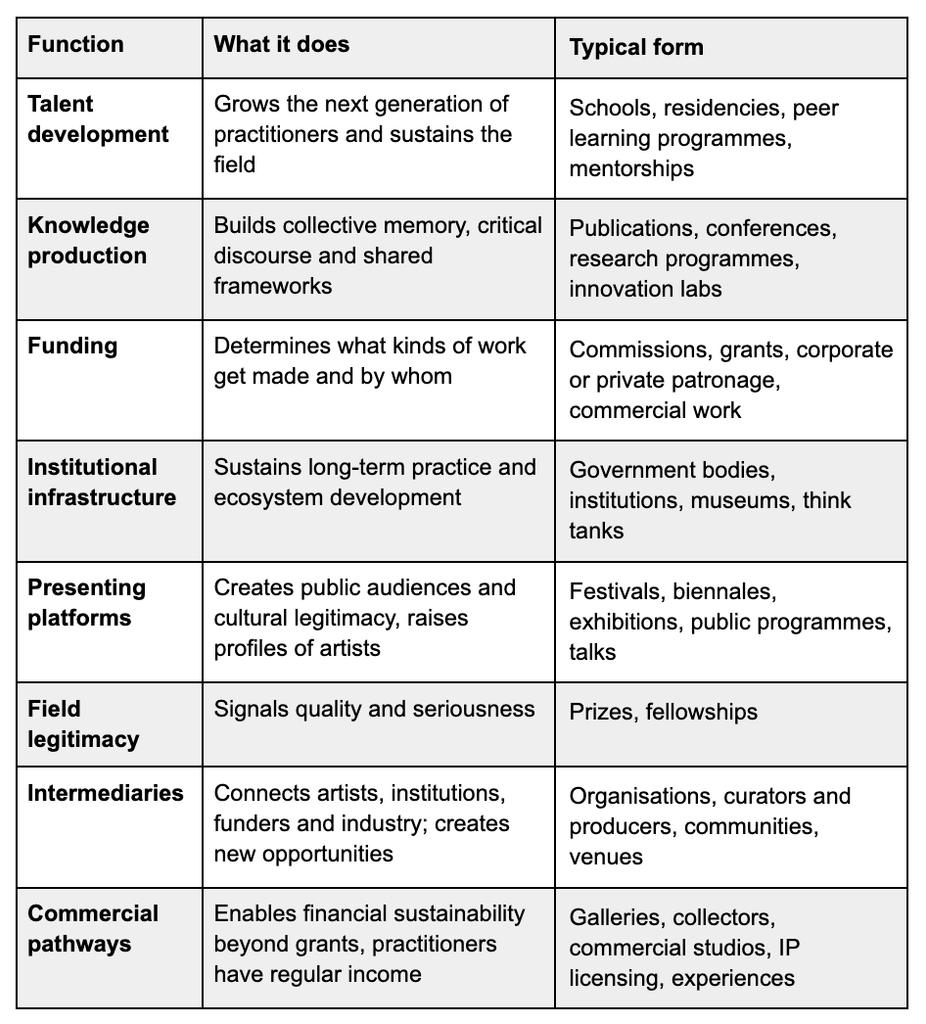
This framework shifts the unit of analysis from organisations to functions because two ecosystems can have the same organisations and labels yet differ enormously in what they actually do. For example, an “art and technology lab” in one country might primarily develop experimental work; in another, it incubates financially sustainable creative technology businesses. The same function may be carried out by different organisations, while a single organisation may perform several simultaneously; it could be distributed across national institutions in some ecosystems, or emerge through artist-run initiatives or informal networks in others.
What this makes visible
Three aspects stand out in the context of art and technology.
Firstly, while the functions lens is analytically useful, in practice, funding still flows through institutional structures. Work may be supported through government commissions, arms-length grants, corporate patronage or innovation labs, earned income and other hybrid models. The source of funding can shape not only what kinds of work are produced and the support they receive, but also the kinds of risks practitioners are able to take.
Secondly, commercial pathways are underdeveloped relative to their potential. Practitioners often have skills and approaches that can translate into commissioned work across creative technology, immersive experiences, consulting and innovation projects. Their technical expertise and interdisciplinary practices allow commercial and artistic work to exist in closer proximity than in many other artforms.
Finally, intermediaries play a particularly important role because art and technology spans diverse sectors including other art forms, science, education, technology, entertainment and industry. Intermediaries can broker relationships, translate between different disciplinary languages, and create unique opportunities that might not otherwise emerge.
How it can be used
This framework can be used as a diagnostic tool to identify gaps, overlaps and dependencies within an ecosystem. It can help clarify where new initiatives might complement rather than duplicate existing work, where investment might strengthen functions that are missing or underdeveloped, and what role an organisation is best placed to play, rather than assuming every organisation needs to perform every function.
Neither the presence nor absence of a function necessarily indicates the health, maturity or vitality of an ecosystem. Nor does it suggest that every ecosystem should aspire to maximise all eight functions.
An invitation
These three frameworks are incomplete and shaped by my vantage point from Singapore. They reflect what I have found useful in making sense of art and technology, rather than an attempt to define it once and for all. Art and technology is often described as an emerging field, and as fields mature, they tend to develop their own language. My hope is that these frameworks contribute to that process by making some distinctions clearer, and that others will test, challenge and extend them.
Acknowledgements
Thanks to Clement Zheng, Debbie Ding, and Rachel Poonsiriwong for providing comments on an early draft of this writing.